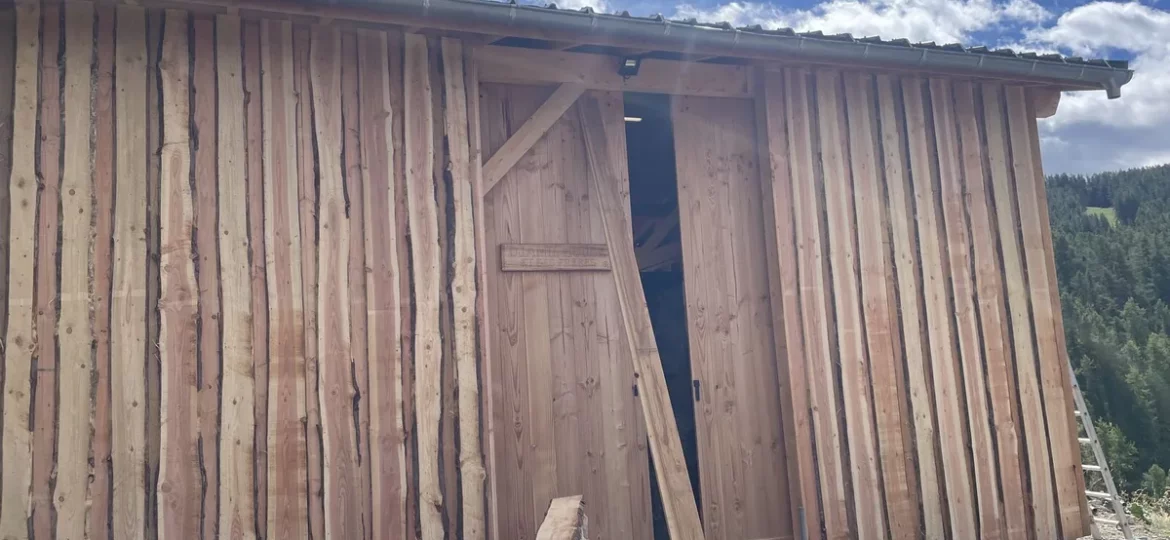
It is one of the questions that comes up most often once the cladding is up or the deck is built: what should it be treated with? The usual answer — “linseed oil” — is the most widespread and one of the least suitable. Here is what the products on the market actually do, and when doing nothing remains the best option.
First: does it really need treating?
Timber exposed to rain and sun turns grey. This change of colour is a breakdown of the lignin at the surface, a few tenths of a millimetre deep. It affects neither the mechanical strength of the timber nor its durability. Douglas fir or larch cladding left untreated will weather to a silvery grey, and will last just as long as if it had been oiled every year.
Treatment is therefore first and foremost an aesthetic choice. It becomes a technical one in two cases: when the species used is not durable enough for its exposure, and when the surface is horizontal — a deck, a sill, a ledge — where water sits instead of running off.
Asking the question in this order avoids a great deal of unnecessary spending, and above all avoids sealing in timber that was doing perfectly well.
Linseed oil, the false good idea
It is cheap, natural, available everywhere and recommended by just about everyone. Outdoors, however, it raises four well-documented problems.
It feeds mould. This is the most serious. Micro-organisms feed on the fatty acids in the oil: in damp conditions, linseed-oiled timber turns black through fungal growth, and the blackening is lasting.
It yellows. Noticeably, especially on pale timber, and ultraviolet light makes it worse.
It dries poorly. Raw linseed oil dries slowly: the surface stays tacky for one to two days and picks up dust the whole time it is curing.
It protects against nothing. It blocks neither moisture, nor fungi, nor wood-boring insects. It changes the appearance; it is no substitute for protection.
It does have a proper place: indoors, on furniture, hand tools, a regularly maintained worktop. Outdoors, it creates more problems than it solves.
Three families of products, three uses
Timber maintenance products fall into two groups according to one simple criterion: do they penetrate the wood, or do they form a film on its surface?
| Product | Behaviour | Used for | Maintenance |
|---|---|---|---|
| Penetrating wood oil | Penetrates, forms no film | Horizontal surfaces: decks, boardwalks, pool surrounds | Clean and recoat, no sanding |
| Wood stain | Thin, microporous film | Vertical surfaces: cladding, shutters, gates | Light sanding, then recoat |
| Hardwax oil | Penetrates and hardens | Indoors: worktops, stairs, table tops | Spot repairs, very simple |
The horizontal / vertical distinction is not a sales detail. On a deck, a film-forming product always ends up flaking, because water sits on it and works its way under the film; you then end up sanding. A penetrating oil, by contrast, wears by gradually lightening and can be recoated without stripping. On vertical cladding, where water runs off, a thin film holds and also provides protection against ultraviolet light.
One last point that is often overlooked: a product must also be chosen according to what was applied before. A penetrating oil cannot go over an old stain film without stripping it first. It is worth noting what you applied, and when.
Wood brightener, to be used wisely
A wood brightener — usually based on oxalic acid — dissolves the grey surface layer and restores the timber’s original colour. It is effective, and it has its place before re-colouring.
Two reservations. It is an acid: it calls for gloves, goggles and thorough rinsing, all the more so as it also damages plants at the foot of the wall. And it is only worthwhile if a finish is applied afterwards — brightening timber only to leave it bare means removing a layer of wood every couple of years for a result that will turn grey again.
What protects better than any product
Three design choices do more for the life of an outdoor structure than any finish, and they cost nothing once the project has been thought through upfront.
- A sufficient roof overhang. Generous eaves keep the facade out of driving rain. It is the most effective protection there is, and the cheapest.
- A ventilated air gap behind the boards. Cladding on battens dries out after every shower. Cladding fixed flat against a background stays damp, and it is lasting moisture that does the damage, not the rain.
- No contact with the ground. Rising damp and splashback are what kill the foot of a post. A few centimetres of clearance above the ground changes everything.
A well-designed structure in moderately durable timber lasts longer than a badly designed one in very durable timber, however generously treated.
The safety precaution people forget
One thing to know before opening a tin of oil: a rag soaked in drying oil can catch fire on its own. As the oil oxidises it gives off heat; in a folded or crumpled rag, or one thrown on a pile, that heat cannot escape and the temperature rises until it ignites spontaneously. Workshop fires start this way every year.
The rule is simple: oily rags should be laid out flat to dry in the open air — or soaked in water before being thrown away. Never screwed up in a bin.
Key points
Before choosing a product, decide whether you want to protect the timber or simply keep its colour. If it is the colour, accept that this is maintenance you will have to repeat. If it is protection, it is decided first and foremost in the design of the structure, and only then in the tin.
And when in doubt, grey timber is not unhealthy timber. More often than not, it is timber that is doing fine and has simply been left to age.